

Every morning was the same.
That uncomfortable tightness in my stomach. The low-level feeling of dread. That panicked voice in my head asking, “What day is this? What am I behind on? Where have I dropped the ball?”
For years, that was my wake-up routine. No one else knew how much I struggled. It wasn’t obvious from the outside, but inside? I was a knot of anxiety from the minute my eyes opened until I crawled back into bed, exhausted.
I’d quit my day job to chase time and financial freedom, and by all accounts I had it. I was working from home, earning triple my previous salary, and I truly did love the work, so what was the problem?
I was running a business entirely in my head.
Every task, every project, every “can you do this?” from a client was a yes, but I was keeping it all in my brain, in a big bucket that was constantly on the verge of overflowing. The only way to prevent disaster was to keep every project and task top of mind, all the time.
Clients told me I was more productive than anyone they knew, but the truth was, I was muscling through every day, terrified of missing a deadline or letting someone down.
All because I didn’t have good systems in place.
I blamed myself. I said I was just lazy. I called myself a procrastinator. I clung to that version of me even when my husband called me out on it, insisting there was a better way to run a business (he was right).
The turning point came when I shifted from service provider to course creator.
Suddenly, I didn’t have someone else’s deadlines to keep me on task. It was just me and a list of projects with no priority or urgency. That’s when I realized my previous “just put out the fires as they appear” system wasn’t going to cut it any more.
I thought I had a productivity problem
At first I thought, “I need a productivity system.”
I read Getting Things Done and Deep Work and Eat That Frog. I tried (and discarded) dozens of to-do apps and calendars. I switched project management software like it was my job. I BuJo-ed. I time blocked. I joined the 5AM club.
None of it helped.
Not because they’re not useful systems, but because what was broken in my business wasn’t a project plan. It was bigger than that. My entire business system was in chaos.
I wasn’t lazy or unfocused. I simply hadn’t defined the repeatable workflows that make my business run smoothly today. I was constantly reinventing the wheel, following every new trend and tool that crossed my desk, when what I should have been doing is building better systems.
How I finally stopped chasing and started leading
My anxiety-filled business was entirely reactive. What I desperately wanted was proactive. The difference is stark.
One is stressful, the other calm.
One is chaotic, the other is predictable.
One saps your energy, the other gives you time freedom.
And the shift from reactive to proactive is simple once you see it.
It’s sitting down to record episode number 137 of your podcast because it’s Thursday and that’s what you do on Thursdays. It’s ignoring all the Black Friday hype because you’re confident that you have everything you need to run your business like a pro. It’s identifying smart ways to boost your email list instead of wasting a month on some hot new strategy before abandoning it in favor of the next shiny thing.
Simple. But not easy.
Four core systems every coach and course creator needs
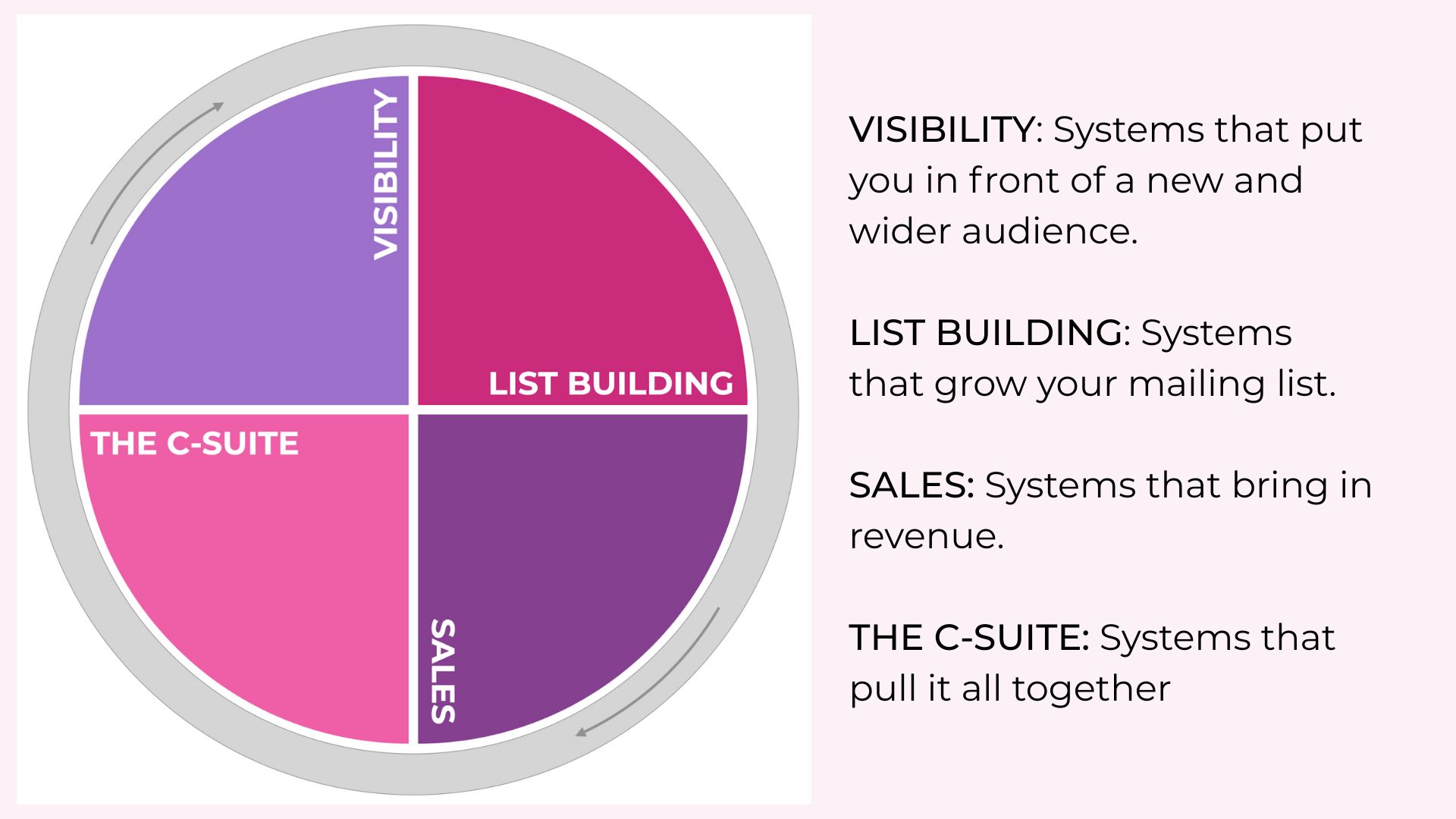
To fix my chaotic, reactive business, I started by identifying the big buckets of activity (systems) that keep my course-based business afloat:
- Visibility
- List building
- Sales
- The C-Suite
Visibility is everything you do to get in front of your ideal audience.
That’s the content you publish on your blog or podcast or YouTube channel, the interviews, speaking gigs, books, ads, and even comments you make on videos or social posts from others. Anywhere you are exposed to a wider audience counts as being visible.
List building is inviting that audience to come back to your house for a deeper conversation.
You can think of visibility as attending a party. There are lots of people there, you’ll talk to and connect with a few of them. Share a few laughs, maybe leave them with something to think about after the party ends.
List building is inviting them back to your place for a more intimate conversation. This is where they can really get to know you outside the loud, chaotic party atmosphere.
Sales is how you solve a problem.
That’s a bit different way of thinking of sales, so let me clarify. When we make an offer, it’s rarely just a “Hey, this will be fun” kind of thing. That kind of sales is reserved for companies like Joker Greeting or Hasbro.
In the coaching and course creation space, sales is service. We are solving a problem our audience is facing, in a way that only we can solve it.
For me, the problem is the chaotic, stressful nature of solopreneur-based businesses. You might be solving the kids who hate math problem, or the mid-life confidence problem, or the feeding a family on a budget problem.
When you’re clear on the problem and confident in your solution, selling is just a matter of making sure people know you have the answer.
The C-Suite is how all of that fits together to form a repeatable, predictable, profitable business that doesn’t suck the life out of you or make you wake up in a cold sweat like I used to.
This is the way you think, how you problem solve, how you make incremental improvements over time to build something real and sustainable.
It’s not chasing a new app or strategy. It’s not beating yourself up for being lazy or unmotivated or “knowing what to do and not doing it.” It’s analyzing the data, identifying the next best move, and implementing the changes that make a real difference.
Instead of just throwing shit at the wall and hoping something—anything—will stick, the C-suite systems help you build strategies that work for you, not for someone else.
These core systems—visibility, list building, sales, and the c-suite—are behind the success of every course creator and coach who isn’t struggling, who isn’t hustling to make rent, who isn’t juggling a day job while they build their side gig into a full-time income.
When you get them firmly in place, you’ll find that:
- You don’t constantly question what to do to grow your business. You already know and you’re eager to get it done.
- You won’t spend time testing new apps and strategies, because you have a system for deciding what you need to move to the next level.
- You aren’t chasing paychecks and hustling for sales. They come effortlessly through the systems you’ve built.
The Swamp of Overthinking
When I explain this very simple systems flywheel, my clients nod along. I can see their eyes light up as the connections are made. Their business feels do-able again.

But then, they wander into the Swamp of Overthinking.
How much content do they need to publish?
How many emails should they be sending?
How often should they make an offer?
How long should their course or coaching program be?
These are the questions that will kill your business. It’s a bad habit left over from the days of believing that this or that new course will save you. You believe you need someone to tell you exactly what to do.
Here’s the truth: No one, not even me, can tell you exactly what to do to grow your business. And here’s a hot take: You don’t really want me to.
The only way that kind of micromanagement is successful is in the franchise world. If you want to be told exactly what to do and when and where and how to do it, buy a McDonald’s franchise. They excel at that shit.
For the rest of us, the only answer is, you get to decide.
That’s what the C-Suite systems are designed for. They let you choose your next steps with confidence, based on your personality, your lifestyle goals, and your audience. You won’t need someone else to tell you exactly how many times you should email your list and exactly how long that course should be.
Your own data will give you the answers.
Anyone who offers a proven, checklisted system is giving you—at best—a starting point. It’s not a prescription and should not be treated as one. Think of it like a faded, coffee stained recipe card handed down from your great grandmother with gems like “add a spoon of cocoa after the mixture has boiled for a while.”
It clearly worked for her, but you’ll need to experiment with the timing and measurements to make it your own.
Your business is the same. You get to take a recipe and make it uniquely yours. I might tell you to email your list every day. I think it’s a good practice, and it’s worked for me for years.
It might be a good fit for you. It also might not. You get to test it and decide for yourself.
The pathway out of the Swamp of Overthinking is clear, but scary:
Just move. Do something. Take action and see what happens. Then do something else. See where it takes you. Do you like that direction? Do more of it. If you don’t like that direction, backtrack and try again.
When you find yourself overthinking, remember that’s what happens when you don’t have decision-making systems. Your brain fills the gap with anxiety.
What’s your next move?
Here’s how to be the kind of business owner who knows exactly what to focus on next—not because someone told you, but because your systems make the next move obvious.
First, map out your business. Do you have:
- Consistent visibility?
- A list-building system that works?
- Something to sell that solves a problem and a way to sell it?
If you have all of those pieces in place, kudos! You’re on the right path.
Now ask, which of these is not working at peak efficiency? Maybe you have a podcast, but you don’t do a great job of promoting it. Maybe you have a lead magnet, but it doesn’t convert as well as you’d like. Maybe you have a great offer, but the sales page kind of sucks.
Identify the next best place to put your efforts, then block off the time on your calendar and get it done.
I made a printable you can use to assess and pinpoint areas of your business that need the most attention right now. It’s free, and you can download it below.