

Every big, hairy project is just a collection of smaller projects all strung together in a specific order.
When I sent an email about it, several people wrote for more clarity. They wanted the steps to follow.
Before I give you that, I just want to say that this isn’t about being more productive. You already know how to be busy. Breaking a big project down into smaller, doable action steps is about finishing what you start—even when it feels overwhelming and hard and like it will take forever.
This is how people who finish projects think.
Here’s my process:
Step 1: Choose the project.
That sounds like a “well, duh!” moment, but hear me out. So many smart, hard-working solopreneurs are drowning in a sea of projects. Everything is a priority, and they’re juggling them all without getting anything done.

But not you. Because you will choose the one best project that will move your business forward.
Make it something that:
- Is hanging over your head and taking up mental bandwidth, and you just want it out of your way, already.
- Is actively blocking progress somewhere else (e.g., you can’t begin promoting your program until you’ve collected testimonials).
- Is tied directly to revenue or business growth.
Step 2: Identify the outcome you’re after.
Clarifying exactly what “done” looks like is harder than it might seem.
An ambiguous example from my own project list is “Systems for Solopreneurs podcast.” Looking at that on a to-do list gives me instant overwhelm. What am I even supposed to do to move that project forward?
So the first step I take is to write a statement that begins with, “This project will be done when…”
In this case, my project is done when: “10 episodes have been recorded and scheduled, and a repeatable workflow is established with another 90 days of content planned.”
Now I know where I’m going, and I can break it down further.
Step 3: Brain dump the deliverables.
They don’t have to be in order, and you don’t have to capture everything at this point. Just get it out of your head and onto paper.
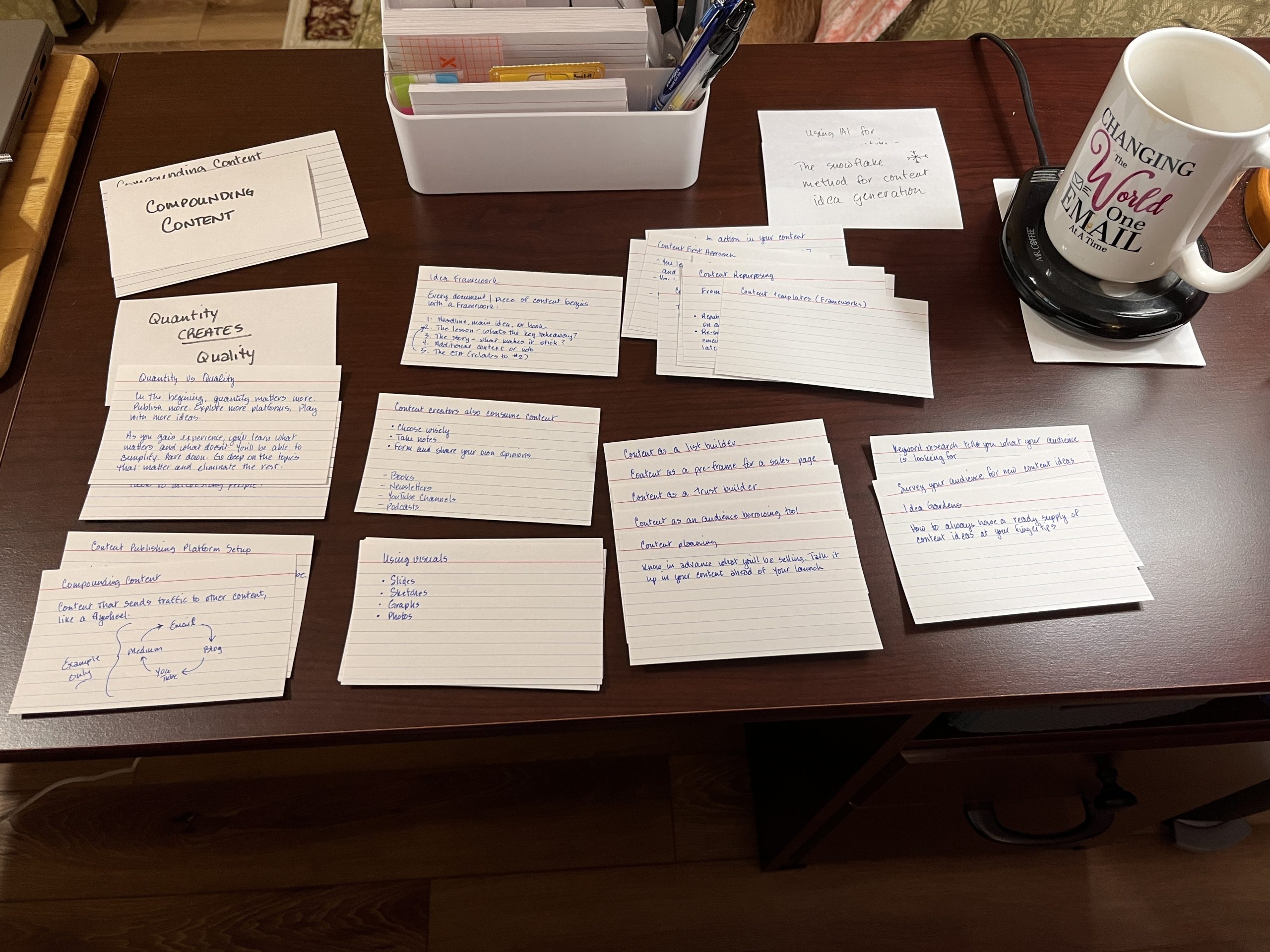
Personally, I use notecards for this, but you can use a legal pad, a Trello board, a mindmap, or whatever tool feels right to you. All you’re doing is making a list, so don’t overthink it.
For my project, my list includes:
- Create channel artwork
- Write description
- Decide on format
- Write intro and outro
- Decide cadence/frequency
There’s more, of course, but this is a good sampling of the kinds of sub-projects you’re after.
Step 4: Ask, “Where do I need more information?”
It’s impossible to know everything you need to know to complete a big project. There will be things you need to research or to gather more info about. In my case, I wanted to understand the pros and cons of YouTube vs audio only, and how I could effectively leverage both platforms with a single show.
You might need to know your best course format options, the best email platform to use, or optimal pricing for your coaching program.

In most cases, you’ll want to complete your research first. It wouldn’t make sense for me to create channel artwork for an audio podcast if I end up going with YouTube. I need that answer before the rest of the projects can be completed.
Beware of this step! As Mark Manson says, “Learning more is a smart person’s favorite form of procrastination.”
Here’s how to avoid research-based procrastination.
First, write down the questions you have (e.g., Can I easily connect Teachable to Kit so I can email my students? Will this email platform let me send a welcome sequence on the free plan?)
Next, give yourself a reasonable boundary. I like a time-based limit like, “I’ll spend 60 minutes finding the answers to my questions, and then I’ll decide.”
You can also choose to stop researching after you’ve found three credible sources or after you’ve had a phone call with a trusted mentor or friend and received their recommendation.
Step 5: Organize your brain dump of small projects.
Here’s where you begin putting things in order. Since you can’t know (no one can) what else might come up throughout the process of completing the big project, don’t worry about getting everything just right at this step. Focus on the next two to three action items.
The “next” action item is the one that unblocks everything else. If it’s not done, other things can’t move forward.
In my case, I’ve already done the research to know that YouTube is a better choice as the primary channel, with audio coming in second, that means I can make the channel artwork and write the description based on what YouTube requires.
I know these are my next steps because I can’t begin publishing videos until they’re done.
Step 6: Create a “done when” statement for the next step you’ll be doing.
My channel artwork is done when I have the artwork installed on my YouTube channel.
Here’s a critical rule of thumb to keep in mind: These smaller, doable projects must be something you can finish in a single, 60- to 90-minute focus session, without stopping to make big decisions or spend more time researching.
Step 7: Begin completing these small, distinct projects, one at a time.
As you complete each one, return to your original list. Is there anything else that came up that needs additional research before you can continue? Are there any other small projects you discovered? Add them to your list.
Now ask again, “What’s the next step?” Remember that the next step is the one that’s holding everything else up.
Give that next step the “done when” treatment, and make sure it’s finishable in a single, focused working session. Then you can add it to your to-do list.
Step 8: Rinse and repeat until you reach the “done when” point for your big project.
When you do, finalize it.
- Physically cross it off your list (so satisfying).
- Archive your project files and notes.
- Delete your research bookmarks and emails.
When you learn to chunk down big projects into small action items, three things will change:
- You’ll no longer feel overwhelmed, no matter what’s going on or how much you have to do or how impossible and confusing it feels.
- You’ll move forward faster than you did before. Like a runner who focuses only on one landmark at a time, you’ll find that small steps add up to big gains very quickly.
- You’ll become a more confident decision maker who gets things done.
If you’re not sure which parts of your business need attention, grab my free worksheet below. In less than 10 minutes, you’ll know exactly which projects are most important, and which ones can wait.